
002: Vitals - The "Warm Shower" Experiment (How I Doubled My Deep Sleep)
Note: This post contains affiliate links to some of the products I use in the Lab. If you make a purchase through these links, I may earn a small commission at no extra cost to you. I only highlight products that are a core part of my actual routine.
A protocol that actually moves the needle.
As I browse wellness protocols on social media, I am equally enthralled and confused while being bombarded with "life-changing" health advice. The videos in my feed tell me to sleep in a sixty-degree room, wear blue-light blockers, tape my mouth shut, take in more salt, take in less salt … the list goes on.
As an executive and a mom, the "wellness-sphere" can feel like a full-time job I didn't apply for. I want to implement wellness protocols, but the advice is overwhelming at best, and oftentimes conflicting. So, I decided to take a "Green Light" approach: take a deep breath, pick one simple thing, and let the biometrics speak for themselves.
The protocol I chose to test? A hot shower one to two hours before bed. The result? A literal doubling of my recovery.
“Total Sleep" vs “Deep Sleep”
I’ve been conditioned to chase "7-9 hours" of total sleep. But my Oura Ring tells me the harsh truth about the quality of my sleep each morning. In the past month, it has shown me the difference between a night of "Yellow Light" recovery versus a "Green Light" recharge depending on my Deep Sleep percentage.
The Deep Sleep Comparison:
Feb 28: The "Yellow Light" Night
Total Sleep: 7h 41m
Deep Sleep: 54m (12%)
The Result: More coffee required, less energetic at the office.
Mar 26: The "Green Light" Night
Total Sleep: 7h 26m
Deep Sleep: 1h 44m (23%)
The Result: Energy to complete my "all green lights" schedule AND shoot hoops with my son that evening.
The bottom line: I technically slept less total hours on the night that resulted in me feeling better. The differentiator was a 93% increase in my Deep Sleep
The Science: Why Deep Sleep is the "CEO" of Recovery
I didn’t spend much time thinking about the different stages of sleep until recently. I’ve now learned that Deep Sleep is like the "maintenance crew" for my brain. It’s the only time the glymphatic system—the brain’s waste-clearance system—actively flushes out toxins accumulated during the day.
This Harvard Medical School article suggests that deep sleep fills an essential role in a person's optimal functioning, and this Sleep Foundation article explains that we spend the most time in deep sleep during the first half of the night. So, if I miss this window because my heart rate is high or my body is too warm to fall asleep when I lay down at 10:00 PM, I can’t "make it up" at 6:00 AM.
But how much Deep Sleep do I actually need? According to this BodySpec article, for most adults, Deep Sleep should make up thirteen to twenty-three percent of total nightly sleep. For my two nights of sleep in question, each roughly seven and a half hours (or 450 minutes) of total sleep, that’s 59 minutes of Deep Sleep on the low end, and 104 minutes of Deep Sleep on the high end. On Feb 28, I didn’t even meet the minimum.
The "Passive Heating" Protocol
I’d heard several influencers mention that a hot shower could help me sleep, which seemed counterintuitive. Why heat up my core before bed when I’m trying to cool down as I hit the pillow?
I dug into the data and learned a new term: “water-based passive body heating”. As detailed in this meta-analysis, a warm shower or bath scheduled one to two hours before bedtime, for as little as ten minutes, significantly shortened sleep onset latency, and is associated with improved self-rated sleep quality and sleep efficiency.
Why and how does this work? This article from The University of Texas at Austin explains that body temperature is involved in the regulation of our sleep/wake cycle, and on average we experience a reduction in core body temperature of about a half to one degree Fahrenheit about an hour before sleep. The hot shower increases blood circulation from the body’s core to the hands and feet and a resulting decline in body temperature, aiding the natural circadian process.
The CEO "Lab Report" Summary
Protocol Tested: A hot shower one to two hours before lights out.
Cost: Free.
Time: Ten minutes.
My Result: Fifty additional minutes of Deep Sleep and a "Green Light" start to my day.
Both the influencers AND the researchers were right about this one. But the Oura Ring proved it with data.
The N-of-1 Disclaimer:
I am an executive and a mom, not a doctor or medical professional of any sort. The content shared here—including biometric data, protocols, and "Vitals" — is for informational and experimental purposes only. It is a documentation of my personal journey and should not be taken as medical advice. Always consult with a qualified healthcare professional before making changes to your health, diet, or supplement routine.
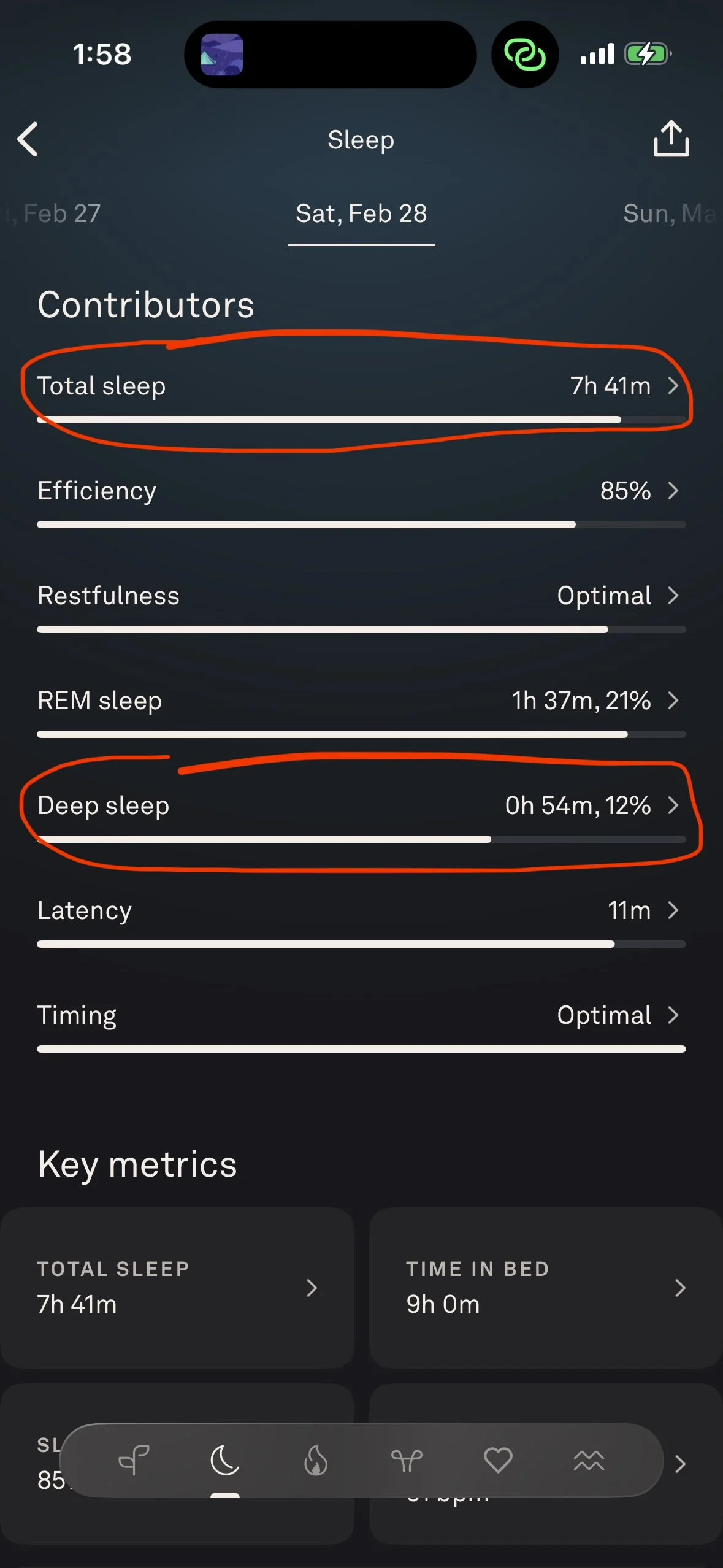
Feb 28, 2026: "Yellow Light" recovery with only 54 minutes of Deep Sleep.
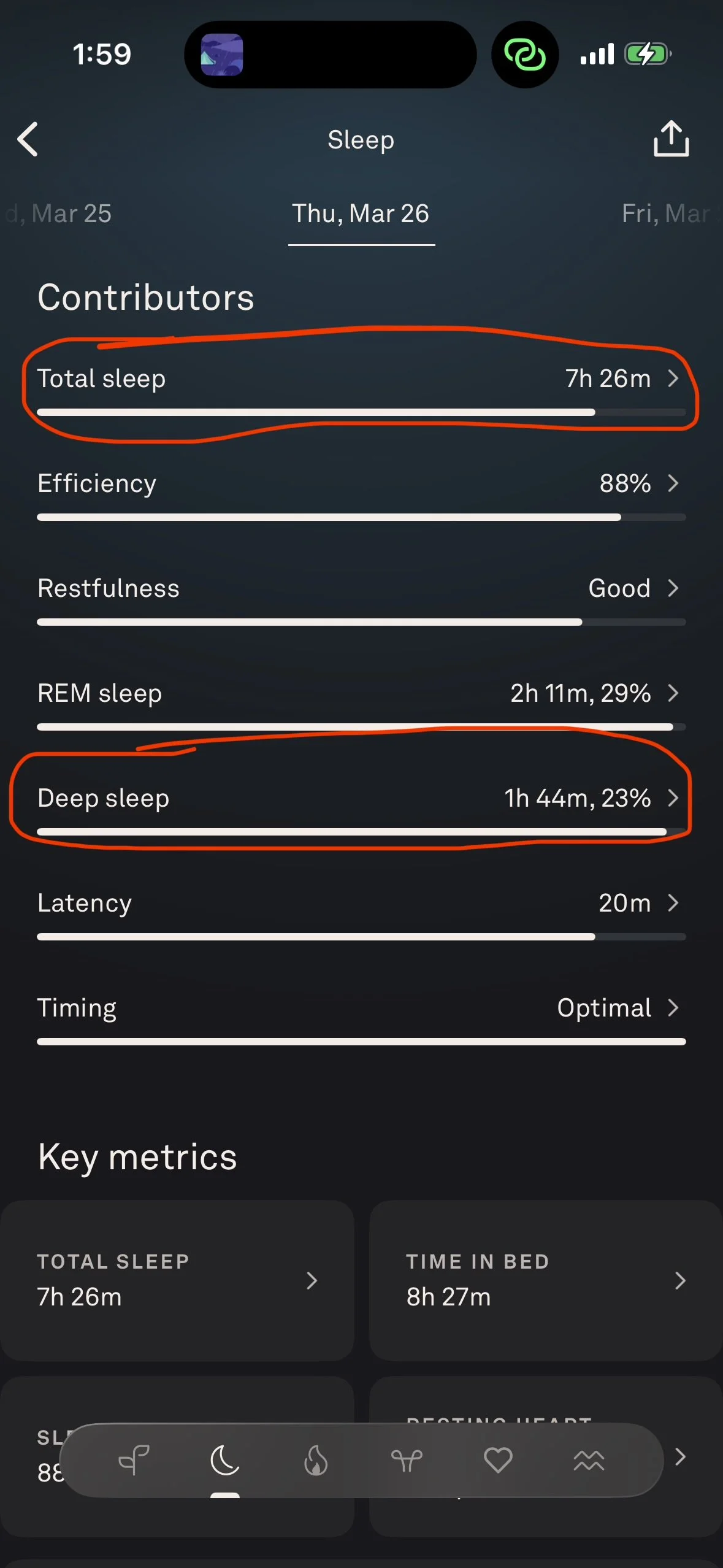
Mar 26, 2026: "Green Light" powerhouse recovery with doubled Deep Sleep (1h 44m).
